
Architects’ Homes: Cora Tuttle
By Michael Bridgeman
The Cora Tuttle House (1909)
Two years ago, I wrote about three Madison architects who designed houses for themselves and their families. This month I write about Cora Tuttle, Madison’s first known woman architect and the only one to practice here until the 1930s.
Not long after arriving in Madison in 1908, Cora Tuttle moved into a house of her own design bordering Vilas Park at 1206 Grant Street. It was “one of Madison’s earliest and best Craftsman-style bungalows.” [a] The term bungalow has roots in India and entered the American lexicon in 1880 by way of England. It initially described a “carefree cottage removed from everyday life” [b] and eventually came to mean a type or form of small house—usually with a low profile of one or one-and-a-half stories, typically of wood frame construction, and with an open floor plan.
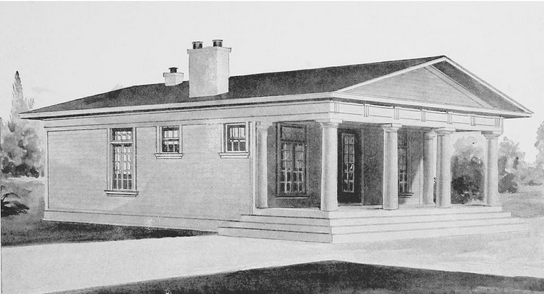
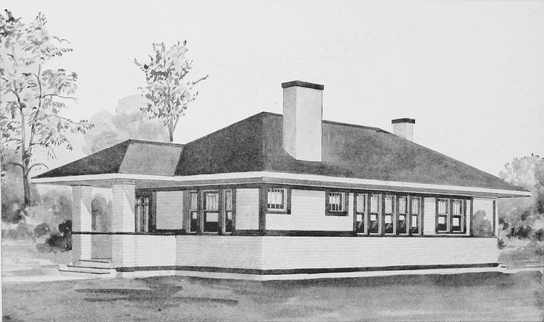
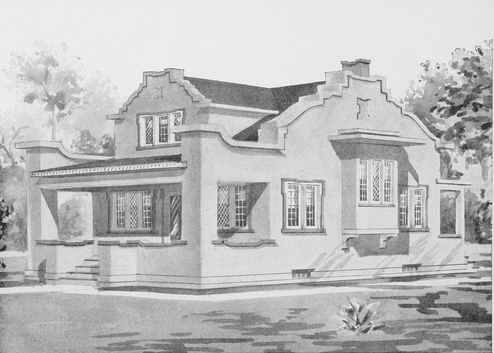
Bungalows could be quite plain or styled in any number of ways such as classical, Prairie, and Mission influences, as shown above in the 1908 catalog from the Radford Architectural Company. [c] Soon after the turn of the twentieth century, Craftsman-styled bungalows took root in Southern California where they became immensely popular and shaped the look of bungalows as they spread quickly across the country.
Construction details
Tuttle’s house embodies the Craftsman spirit. The form and materials are straightforward. Clapboard siding covers the first story and the roof has exposed rafter tails. Double-hung windows—with multiple panes in the upper sash and single panes below—are mostly arranged in groups of two or three. Multicolored rocks form the chimney, foundation, and piers for the porch; reddish-brown mortar emphasizes the random arrangement of fieldstones. A broad porch stretches across the main façade under a second-story gable faced with shingles. Carpentry details amplify the Craftsman aesthetic. Simple brackets, blocks, and exposed purlins are found under overhangs and eaves. Doubled porch posts are joined by braces that hint of Asian influence, as do the open porch railing and the flared tip of the gable. The Journal of Historic Madison describes the interior: “The feeling of the house is extremely rustic and homey, with much woodwork, beamed ceiling, and fieldstone fireplace inside...” A large L-shape chamber combines the living and dining rooms, the kitchen is at the rear, and bedrooms are on the first and second floors. [d]
Cora Tuttle, 1924 [1]
Born in 1864, Cora Cadwallader grew up in the Town of Brooklyn south of Madison, where her father was a carpenter. She and her husband Charles Tuttle had three sons and they moved to Texas in 1904 and then to Arizona, where she may have seen California bungalows in the Craftsman style. Recently widowed, she returned to Wisconsin so oldest son Ray could attend engineering school at the University of Wisconsin. She had done drafting while attending college and used her talents to design her own house, thus becoming Madison’s first woman architect. Cora Tuttle wasn’t a full-time designer. She was also a secretary and draftsman for Frank Hall, a lawyer and developer, and she worked with him on several housing projects. Cora Tuttle lived in the Grant Street house until 1930 when she moved to New York. She died in 1948.
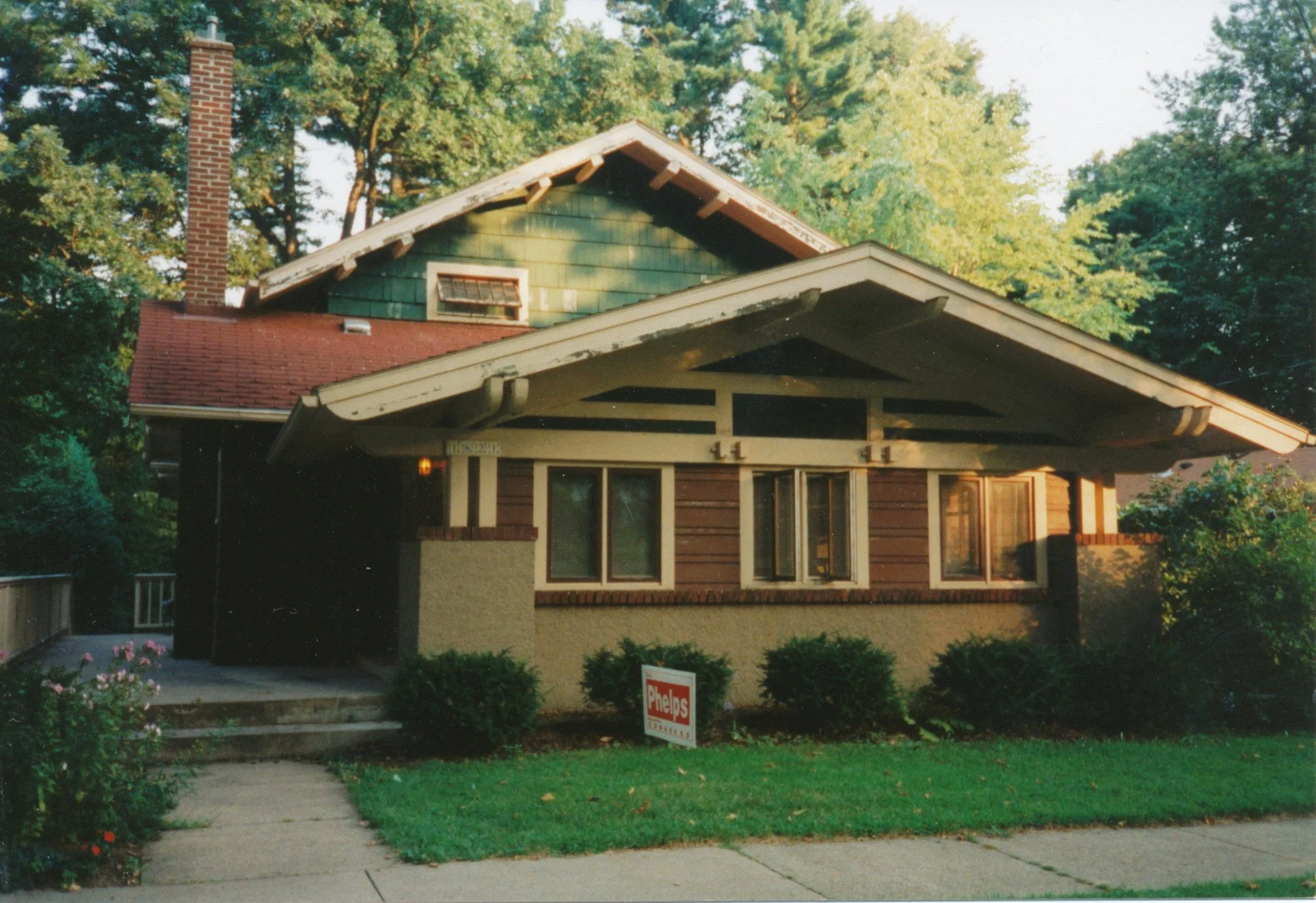
1821 Vilas Ave. [2]
There are three clusters of Cora Tuttle’s houses in Madison. The first is near her own home, where four more Craftsman bungalows were built. Next door, at 1202 Grant Street, is a house she designed for her sister Marie and Edgar W. Smith. Three more bungalows are around the corner at 1811, 1813, and 1821 Vilas Avenue. Her nephew Edgar C. Smith collaborated on some projects, as did her son Ray.
![A.M. and Zell Pardee House (1912) [3]](https://images.squarespace-cdn.com/content/v1/5c40df4ef93fd497c87fd880/1774557471985-52TR4BAQ399W2N5GO7ZD/Prospect+841+AHI+91791+copy.jpg)
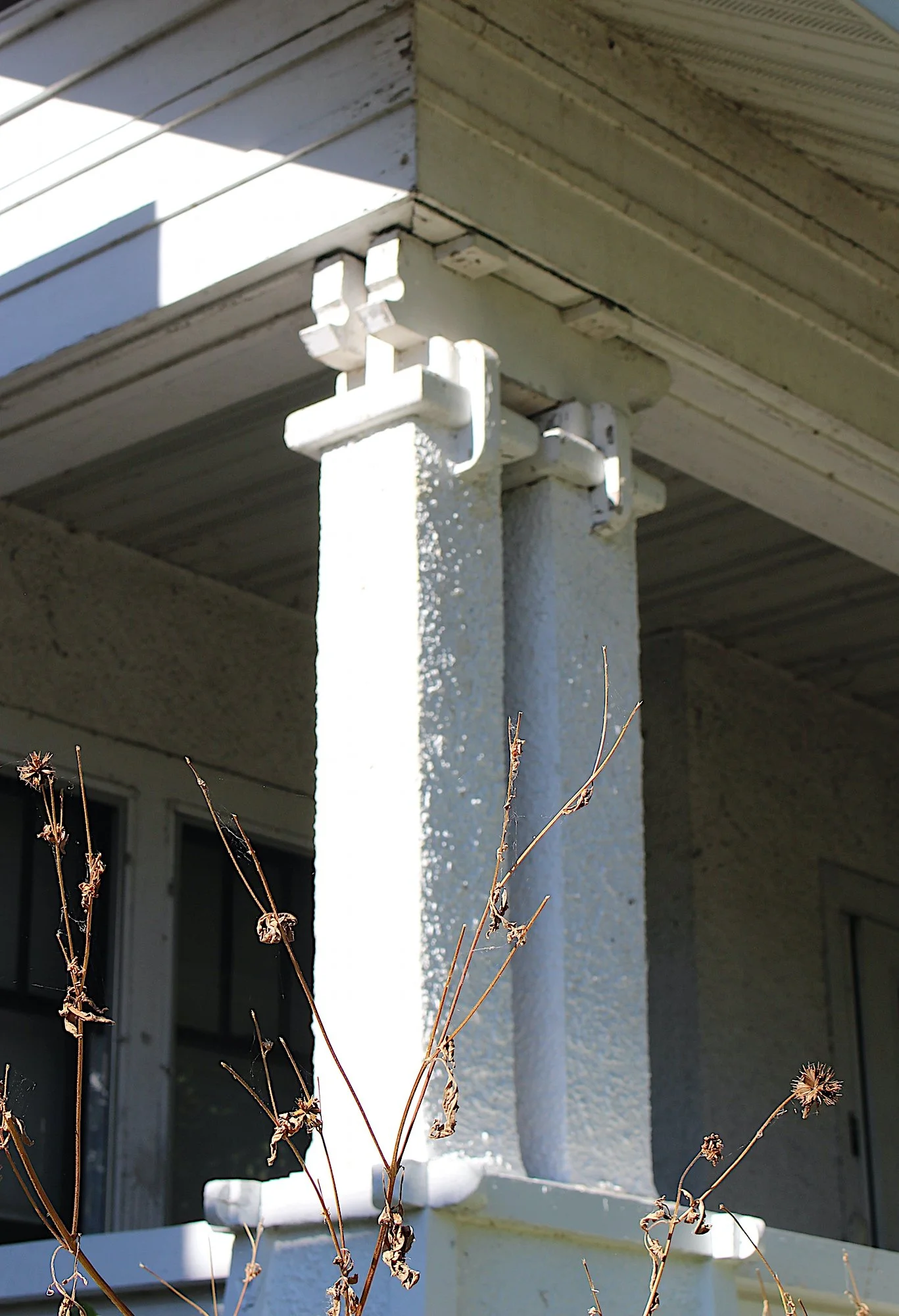
A second grouping in the Tenney-Lapham neighborhood was developed by Frank Hall, who was Tuttle’s distant relative in addition to being her employer. The A.M. and Zell Pardee House (1912) at 841 Prospect Place is the most visible of the houses and the clearest expression of the Craftsman style with stucco cladding, rafter tails, generous screened porch, and long shed dormer. Tucked behind it is a nascent bungalow court, a planning concept that also blossomed in California. Three bungalows on Russell Walk are tightly spaced, with Craftsman touches found in details such as the porch posts at 814 Russell Walk (1911-1914), which are topped by elaborate, Asian-influenced joinery.
Thompson Bungalow (1910)
The third bungalow cluster has remnants of an ambitious development project at the east end of Lake Monona around present-day Lake Edge Park. Frank Hall was the principal investor in the Lake Edge Real Estate Company, Cora Tuttle was secretary, and Edgar C. Smith was sales manager. A handful of houses designed by Tuttle were built, but the subdivision didn’t take off; some have been demolished. The Thompson Bungalow (circa 1916) at 4010 Drexel Avenue shows her deft hand. The masonry on the porch piers is identical to the foundation work at the Tuttle House, though here the hefty posts are tripled and support exposed beams. The gable has a pagoda-like peak, as at the Cora Tuttle House.
See for yourself
Cora Tuttle’s work is featured in two of the Madison Trust’s Historic Architecture Walking Tours, including her family home on Grant Street in the Vilas neighborhood and her Prospect Place bungalows on the Prospect and Castle Place tour. While these tours aren’t on this season’s schedule, they’ll return in the future. For those especially interested this year, private tours of the Vilas or Prospect and Castle Place neighborhoods can be arranged.
Tuttle’s own house is a contributing resource in the National Register-listed Wingra Park Historic District, as are the four nearby bungalows she designed. All four of Tuttle’s designs on Prospect Place and Russell Walk are contributing resources to the National Register Fourth Lake Ridge Historic District. Her house for John and Ella Commons (1913) at 1645 Norman Way, is individually listed on the National Register of Historic Places. It is also a designated Madison landmark.
Addresses are included above to make it possible to see the houses in person. It is important to respect the privacy of residents and remain in the public right of way.
Notes
[a] Katherine Rankin and Timothy Heggland. “Madison Intensive Survey: Master Architects, Draft.” (City of Madison and Historic Preservation Division Wisconsin Historical Society. 2006) p.252-253.
[b] Diane Maddex and Alexander Vertikoff. Bungalow Nation. (Abrams, New York N.Y. 2003) p.11.
[c] Radford’s artistic bungalows; a unique collection of 208 designs. (Radford Architectural Company. Chicago, Ill. 1908.) Accessed through Internet Archive. https://archive.org/details/radfordsartistic00radf/mode/2up
[d] Robert J. Shockley. “The California Bungalow and Its Influence in Madison.” The Journal of Historic Madison. (Historic Madison Inc., Madison, Wis. 1978.) p.4. Shockley notes that, “University of Wisconsin President Charles Van Hise, a geologist, gave advice on rock for the fireplace chimney.”
Image Credits
[1] “The California Bungalow and Its Influence in Madison.” The Journal of Historic Madison. (Historic Madison Inc., Madison, Wis. 1978.) p.3.
[2] Wisconsin Historical Society Architecture & History Index. AHI #37337.
[3] Wisconsin Historical Society Architecture & History Index. AHI #91791.
All other photographs by Michael Bridgeman