
Blog

Uncovering Madison’s Railroad Past
Railroads—instrumental to the making of the United States as we know it—played a profound role in Madison’s growth and development. At their zenith, steel rails of three companies fanned out from the city in nine directions. Around the turn of the twentieth century, well more than one hundred trains (freight and passenger combined) rolled over those lines everyday. Rail declined across the country following World War II and the last passenger train pulled out of Madison in 1971, but freight service began to rebound in the 1980s. Evidence of Madison's railroad past is all over the city. Discover some of it in this blog post by Scott Lothes, president and executive director of the Center for Railroad Photography & Art (www.railphoto-art.org), the Madison Trust's partner in this year's Specialty Tour.

Parade of Homes 1998
This month I look back only 25 years to the 1998 Parade of Homes presented by the Madison Area Builders Association (MABA). I appreciate that 25-year-old houses may not be “historic” to many preservationists. The Madison Landmarks ordinance has no minimum age requirement, while the National Register of Historic Places generally requires that properties be at least 50 years of age. In fact, houses of any age have things to tell us about design, social status, marketing, and more.

The Bowens Make Their Mark
Madison got off to a slow start. It was a city on paper when selected as the territorial capital in 1836. Ten years later, when Madison received its village charter, there were only 626 residents. But soon, the boom began and Madison attracted entrepreneurs and hustlers, capitalist and swindlers, opportunists and optimists. When chartered as a city in 1856, the population was 6,863. Among the newcomers were James and Susan Bowen, who arrived in 1852.

Prow Roofs 2 | Places to Live, Work and Play
The prow roof saw widespread use in the years following World War II, projecting an image of the modern in a country energized by unprecedented growth. At their most exuberant, prows that soar evoke the Jet Age, while more commonplace uses demonstrate the adaptability of the form. Last month I focused on places of worship and this month I turn my attention to the prow roof in residential, commercial, and recreational applications.

Prow Roofs 1 | Places of Worship
The prow roof has a long history, but is best known today for its use in mid-century design from the 1940s to the 1970s. Twentieth-century prows are the focus of my posts for the next two months, first highlighting ecclesiastical prows and then featuring prows on nonreligious buildings next month. As is my practice in these posts, the emphasis will be on local buildings which are easily seen in person, though I’ll expand my scope with examples from elsewhere in Wisconsin.
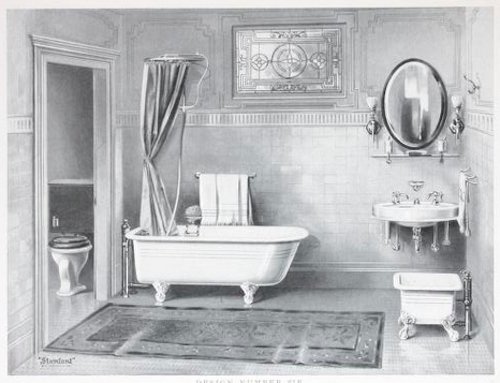
From Privy to Bathroom
When Mayor Albert Schmedeman presided at the opening of Madison’s Nine Springs sewage disposal plant in June of 1928, he also formally put James Mackin in charge of the new facility. In his first city job in 1897, Mackin supervised laying a sewer line as Madison prepared to open its first sewage treatment plant. He was named superintendent of the system in 1916, a job he held until his death at 66 in 1930. Mackin’s 33 years on the payroll saw big changes in Madison’s treatment of wastewater and its quality of life.

Postcard Pairs
Buildings change over time. That’s self-evident. It’s also true that there are myriad resources to find out how change comes to the places we build, alter, and (sometimes) demolish. This month I’ll focus on postcards as records of how several buildings have changed.

Preserving the Memory of Style & Grace
For long-time residents of South Madison, the title of Linda Friend’s 2010 documentary “Style & Grace” needs little explanation. They know that Style & Grace was a barbershop at 1610 Gilson Street that served as a gathering place for the city’s Black community for decades. This past November 3rd, the Madison Trust’s Community Education Comittee was proud to co-host a screening of the film, which shows a day in the life of the barbers, their customers, and the sense of neighborhood belonging they sustained.

‘Tis the Season for Giving
Finding the right holiday gift can be a challenge and while the Madison Trust may not have matched pajama sets or fruitcakes, we have plenty to offer those on your list. A present of the past is always in fashion whether it’s historic architecture walking tour tickets, Madison Trust t-shirts, an annual membership or notecards. Here is our annual list of giving ideas for those who love fine vintage buildings.

Period Revival Houses: French
For some time, a house at the corner of Spooner Street and Keyes Avenue has caught my eye when taking the back way to Trader Joe’s on the west side. It fits my notion of a “French Provincial” house, a style that doesn’t get much attention relative to competing period revivals—Colonial, Tudor, Georgian, Mediterranean—that blossomed in the early twentieth century. The house at 1802 Keyes Avenue (1928) got me to thinking about French-style houses in our area.

Reckoning and Preserving: Historic Preservation, Public History, and Legacies of Racism in Madison
This fall the Chazen Art Museum is hosting "Sifting and Reckoning: UW-Madison's History of Exclusion and Resistance." The exhibit is the culmination of the university's three-year Public History Project to examine legacies of racism on and near campus. Our Community Education Committee Chair, Kevin Walters, provides an overview of the project and explains why anyone interested in historic preservation should take the time to visit. It's free and open to the public during museum hours from September 12th to December 23rd.

St. John’s: Constancy and Change
In 1951 St. John’s Lutheran Church in Madison, “established the principle that any expansion of facilities should be at our present location. We would be a central city congregation, attempting in as many ways as possible to serve people in the central city.” At the time of this declaration, the congregation was nearly 100 years old and had been at home at the corner of East Washington Avenue and North Hancock Street for 83 years. Today, 71 years later, St. John’s is on the same site with big plans to remain. If the future unfolds according to a proposal in the works, as soon at 2025 St. John’s would be housed in a new, ten-story high-rise with space for local nonprofits and more than 100 affordable housing units.

Silver Linings
We all know that places hold an incredible power. The stories told by our older places are what make our communities distinctive, give them unique character, and make them a someplace instead of an anyplace. We all have places that mean the world to us personally, and we’ve all felt the power of being in the very spot where something significant happened to change the course of history. No book or image can quite capture being there. When we lose these places, however, we lose not only that history, but the ability of today’s and future generations to access those stories. We lose not just the past but the future.


Strolling at Forest Hill Cemetery
There was a time, before public parks were commonplace, when Americans would routinely visit cemeteries as picturesque retreats. This was especially true of so-called rural cemeteries that became popular in the 19th century. In the spirit of our ancestors, I recently took a leisurely walk through Forest Hill Cemetery, paying special attention to the design of gravestones, which don’t usually get much attention when we think of the built environment. Yet the ways we mark places for the dead, whether conventional or unusual, are devised very intentionally.

Trachte Buildings
Trachte buildings are a common site across the Madison area. Vintage Trachtes are easy-to-identify corrugated steel buildings with vertical walls and an arched roof that were used as garages, utility sheds, gas stations, boathouses, or commercial buildings.

Stone-Faced
From the earliest days of building in stone, the human figure has often been part of these structures. People are attracted to artistic representation of the human form, particularly the face. A human likeness on a building can be somber or playful, explicitly instructive or merely decorative. And buildings—at least the exteriors—are the most public of art.

New to the National and State Registers
Two years ago, I wrote about additions to the National and State Registers of Historic Places. Identifying and recognizing worthy properties is an ongoing activity, so an update is in order. In 2020 and 2021, there were five additions to the registers in Madison and Dane County—two houses and three historic districts. Read on to learn more.

Raising the Roof
For a design that was born in 16th century France, the mansard roof has had remarkable staying power. In its 400-year history the distinctive roof has adorned everything from grand French chateaux to Gilded Age hotels and American fast-food restaurants.

Gifts of the Season
This holiday season promises renewed opportunities to gather with friends and family. And while supply chain problems may persist, they won’t interfere with purchasing a gift from the Madison Trust, where we think a gift of history and preservation is always in season! Read on for a number of thoughtful suggestions for your holiday giving.