
Field Notes #2
By Michael Bridgeman
Field Notes is an irregular series of brief observations, updates, asides, and occasional insights about the Madison area’s historical built environment.
Three Books
This entry of Field Notes highlights three books of interest for those who enjoy and explore Madison’s built environment. Two give the backdrop for buildings past and present while the third is a fanciful look at real places and what might have been.

A Keg of Their Best: Brewing in the Beer State Capital—From the Beer Baron Era to Modern Microbrews (2026)
by Robin Shepard
While A Keg of Their Best is about beer, it is inevitably about the places beer has been brewed in Madison and Dane County. Author Robin Shepard, an experienced local beer writer and enthusiast, reminds us that beer making in Madison goes back to the 1840s, soon after the community was established. Useful maps locate early breweries in the city and the county. Historical photographs and illustrations give further evidence of the physical context for the business of beer and related enterprises like hops growing, ice harvesting, barrel making, and bottling. Shepard writes about the social, economic, and political forces that have affected the making and consumption of beer over 180 years, including the Prohibition era of a century ago and the rise of craft brewing in the 1980s. We learn about Madison’s first brewers—Sprecher, Hausmann, Fauerbach, and others—as well as contemporary makers, some of which have come and gone to become part of the historical record.
See more at Madison Magazine.

The Rise of Breese Stevens Field (2025)
by David Michael Miller
The Rise of Breese Stevens Field is about much more than the familiar facility. It details the “how” and “why” of the place with a low physical profile that has a big presence on East Washington Avenue. The stadium was built for high school sports programs and a wide variety of other events—athletic and otherwise. The book details the social and political context that led to the stadium’s construction, took it through its glory years, and motivated renovations and upgrades that have breathed new life into the now 100-year-old facility. Central to Miller’s story is the Madison Blues baseball club that called Breese Stevens Field home from the stadium’s opening day in 1926 to the Blues’s final game in 1942. Along the way, Miller introduces us to local notables including widowed socialite Elizabeth Farmer Stevens, legendary columnist and sports enthusiast Joseph “Roundy” Coughlin, pro wrestler Jimmy Demetral, and “softball fanatic” Duane Bowman.
See more at The Capital Times and hear more at WORT-FM.
The Gallery of Lost Gargoyles (2025)
by Jim Good and Bob Kann
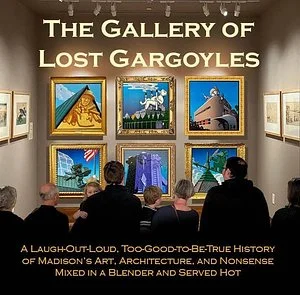
The hyper-hyphenated sub-title for The Gallery of Lost Gargoyles lets readers know what they’re in for: “A Laugh-Out-Loud, Too-Good-To-Be-True History of Madison’s Art, Architecture, and Nonsense Mixed in a Blender and Served Hot.” It’s a quirky and whimsical look at gargoyles now presumed lost or never installed on twenty-one Madison buildings. Starting from a solid historical base, authors Jim Good, a retired architect, and Bob Kann, a historian and storyteller, spin fantasies around those places and gargoyles that might have been. Each instance is cleverly—some might say incredibly—imagined by Good’s amusing illustrations, reproduced from color linocuts. Additional words and pictures describe fantastic tales about 170 years of grotesquery, from North Hall (1851) to MYArts (2021) and leave few stylistic stones unturned with entries on Gothic, Greek Revival, Tudor, Beaux Arts, Prairie, and Modern buildings.
See more at The Capital Times and hear more at WORT-FM.
Finding the Books
All three titles are available through the South Central Library System. Copies can may also be found at many of the bountiful bricks-and-mortar bookstores in and around Madison. If you prefer to order online, consider visiting Bookshop.org, a site which allows you to designate a local bookstore to receive the profit from your purchase.